
Commercial and property managers
Gutter Budget Planning for HOAs
By the V&V Seamless Gutters crew · Published and updated November 1, 2026

A workable HOA gutter maintenance plan has two budget lines: a yearly operating line for cleaning and small repairs, and a reserve line that saves for replacement. Build both from a measured inventory of every run, not from last year's invoice. That inventory is the step most boards skip, and it is what makes the rest of the budget defensible.
What goes in an HOA gutter maintenance plan?
Five pieces cover it. A board can put them together in one working session once the measurements exist.
- Scope. Which gutters the association owns, and which belong to owners.
- Inventory. Linear feet, stories, metal, age and condition by building.
- Operating line. Cleaning frequency and an allowance for repairs.
- Reserve line. Replacement cost spread over useful life.
- Calendar. Who does what, and when, with records kept.
Need gutter runs measured for a budget? Call (208) 464-4195 to ask about a free estimate and written line-item quote.
- 4.5★ from 36 Google reviews
- Free estimates
- Run by owner Victor and his son Omar
Who pays for which gutter?
Start with the governing documents, because no plan works until this is settled. Some associations maintain building exteriors, including gutters. Others leave them with each owner. Townhome and condominium communities often differ from single-family subdivisions, and any one declaration can carve out exceptions. Read the declaration and ask the association's attorney if the language is unclear. We are not giving legal advice here, only pointing at the question to answer first.
Where owners are responsible, the board may still want a standard. Color, profile and downspout placement can all be written into architectural guidelines so that repairs do not leave a patchwork.
How do you build the gutter inventory?
Measure once, then keep it updated. One row per building is enough.
| Field | Why the board needs it |
|---|---|
| Linear feet of gutter | The base number for every quote |
| Downspout count and size | 2x3 drains about 600 sq ft of roof, 3x4 about 1,200 sq ft |
| Stories | Access drives labor cost |
| Metal and gauge | .027 aluminum is the common professional standard |
| Year installed | Sets the replacement date |
| Tree cover | Sets cleaning frequency |
| Discharge | Where the water goes, and if it reaches 6 feet |
| Condition notes and photos | Backs up the budget at the annual meeting |


What should the yearly operating line cover?
The operating line pays for what happens every year. Set cleaning frequency by building, not across the whole community, because a building under oaks and one in open sun do not need the same schedule. Published guidance sets the minimum at about twice a year, with extra visits after major storms. Delaware's environmental agency gives that same twice-a-year figure, in spring and early fall.
Ask for commercial gutter cleaning quotes per building with access costs shown, then add a repair allowance for hangers, seams and extensions. Do not plan around one citywide figure. Buildings differ too much, so use your own bids.
What a cleaning bid should state
Have each bidder write the visit down, so the board can tell what it paid for.
- Downspouts. Flushed and confirmed running at the outlet, not only scooped at the top.
- Debris. Bagged and hauled, with nothing left on lawns or walks.
- Resident notice. Who tells residents, how far ahead, and what happens with gates and parked cars.
- Report. Dated photos by building, with loose hangers and failed extensions listed.
- Extra work. A set rate or an approval step, so small repairs do not appear on the invoice unannounced.
How much should the reserve line carry?
Divide replacement cost by useful life, and use a range rather than a single number. National contractor tables commonly list aluminum gutters at 20 to 30 years, which is not Austin data. A national listing shows $7 to $15 per linear foot installed in Austin. Those figures are for planning and are not V&V prices.
Here is the arithmetic for a hypothetical section with 2,000 linear feet of gutter:
| Input | Low end | High end |
|---|---|---|
| Cost per linear foot | $7 | $15 |
| Replacement today | $14,000 | $30,000 |
| Useful life | 30 years | 20 years |
| Yearly reserve contribution | About $467 | $1,500 |
Treat that as a floor. Multi-story access, added downspouts and rising labor costs can all push the real figure up, and sections installed at the same time can come due at the same time. Replacing a mix of old stock in stages can smooth that out. Have the reserve professional or manager update the numbers with live bids.
Where do gutter guards fit?
Guards move money from the operating line into a one-time cost. Angi puts guards in Austin at about $5 to $13 per linear foot, so the same hypothetical 2,000 feet comes to $10,000 to $26,000. That only pays where cleaning bids run high, on buildings with heavy oak cover or tall access. Guards reduce cleaning but do not remove it, so keep a smaller cleaning line. Price them by building and start under the worst trees.
What about a hail or wind year?
Storm damage fits neither line. If the association insures the buildings, ask the manager for the policy's deductible and decide now how the board would fund it. The Texas Department of Insurance says a contractor cannot offer to waive, rebate or absorb a policyholder's deductible, so treat any bid that promises it as a red flag.
Do lenders care about reserves?
For condominiums, yes. A law firm analysis of Fannie Mae's Lender Letter LL-2026-03 says the minimum reserve allocation for condominium projects rises from 10 to 15 percent of the budget, effective January 2027, with stricter reserve study terms. Mortgage trade groups have asked for a pause, and details may change. The analysis addresses condominium projects, so do not assume it reaches a single-family HOA.
State law is a separate question. A National Association of Mortgage Brokers paper says Texas has no reserve study mandate, but read that as a trade group's summary and ask your association's attorney to confirm what applies to you. Gutters are a small part of a reserve budget, but a well-supported line is exactly what a reviewer wants to see.
Where shared gutters cost boards money
On multi-unit buildings generally, a few patterns stand out.
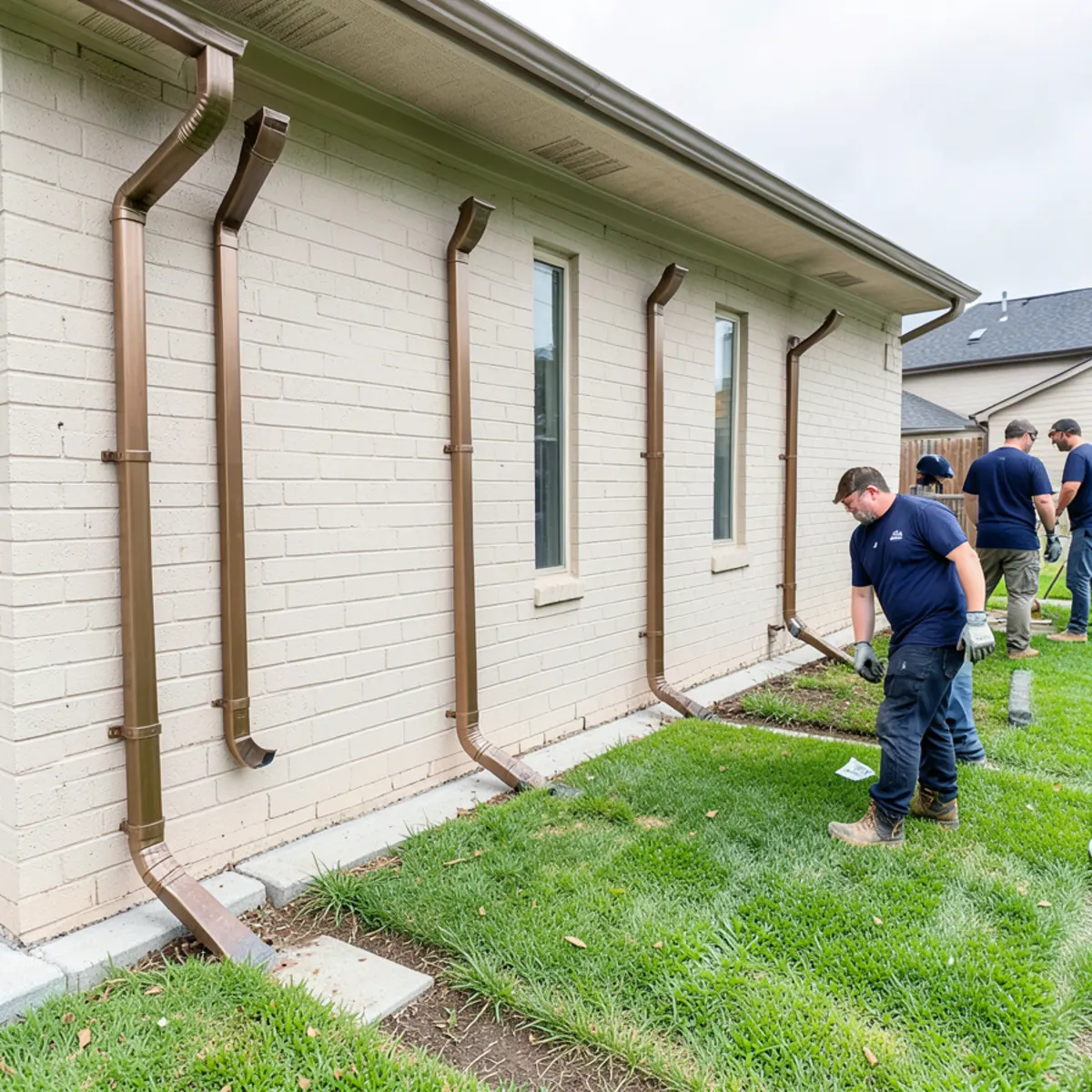
- Discharge problems outlive gutter problems. On expansive clay, such as the slab subdivisions around Pflugerville, the fix is often extensions that reach 6 to 10 feet from the foundation.
- Shared walls create shared runs. One clogged downspout can back water up across two or three units.
- Builder-grade downspout spacing shows up as overflow at inside corners. About one per 30 feet of gutter helps.
- Without records, the same gutter repair gets paid for twice.
Standards help, but they have limits. One gauge, color and profile across a community keeps repairs simple and the street matched. One downspout layout does not work everywhere, because roofs and lots differ from building to building. Standardize what shows and size what drains. Bundling cleaning and repairs with one vendor has a similar trade-off. The manager gets one number to call, and the board loses a regular price check, so ask for line-item pricing and rebid on a set cycle.
Turn the plan into a calendar
Set the dates when the budget is approved, so nobody is scrambling in May.
- Late winter: bid cleaning and repairs for the year.
- Spring: clean after the live oak drop, then flush every downspout before May, Austin's wettest month on NOAA normals.
- Summer: complete repairs and replace failed extensions during the dry months.
- Early fall: second cleaning, plus a walkthrough with photos.
- Budget season: update the inventory, record actual costs and adjust the reserve line.
Scope for HOA and multifamily gutters varies by community, so ask what fits yours and get it in a written quote. A plan with measured feet, dated records and a simple calendar will hold up better at the annual meeting than a round number carried forward from last year. Call us to have a section measured. The estimate is free, the quote is written, and the footage goes straight into your inventory.
Sources
- Winstead analysis of Fannie Mae Lender Letter LL-2026-03, via JD Supra
- National Association of Mortgage Brokers, white paper on LL-2026-03
- Delaware DNREC, Clean Gutters adaptation sheet
- NOAA NCEI, US climate normals 1991-2020
- Angi, gutter guard costs in Austin
- Texas Department of Insurance, roofing and insurance: know the law
Common questions
Should an HOA replace all its gutters at once?
Not always. One contract can win a better rate and keep colors uniform, but it also means a large reserve draw in one year. Phasing by building spreads the cost and lets you start with the worst sections. Ask for a quote that prices both ways, then let the condition data and reserve balance decide.
How should a board compare gutter bids?
Compare the lines, not the totals. Ask every bidder to state linear feet, gauge, size, downspout count, discharge, access and removal, per building if possible. Then ask for insurance certificates and confirm them with the agent, since Texas has no state gutter license to lean on. A bid that omits a line is a different job, so ask what it leaves out.
How long should an HOA plan on gutters lasting?
Plan on 20 to 30 years for aluminum, using national contractor tables, then adjust with your own inspection notes. Those tables are not Austin data. A 2000s subdivision in Pflugerville may be entering that window now, so a dated condition walk tells the board more than the install year alone.
How often should an HOA schedule gutter cleaning?
At least twice a year, set building by building. Spring after the live oak drop and early fall cover most communities, with downspouts flushed before May, Austin's wettest month. Buildings under heavy canopy may need a third visit, so write the frequency into the bid instead of one schedule for the whole property.
About the author
Written by the crew at V&V Seamless Gutters, the Austin gutter company run by owner Victor and his son Omar. Read more about us or see what customers say.
Related service: hoa and multifamily gutters in Austin. We also work in Pflugerville.
Have a gutter question this article did not answer?
- 4.5★ from 36 Google reviews
- Free estimates
- Run by owner Victor and his son Omar