
Commercial and property managers
Box Gutters vs K-Style Gutters on Commercial Buildings
By the V&V Seamless Gutters crew · Published and updated November 1, 2026
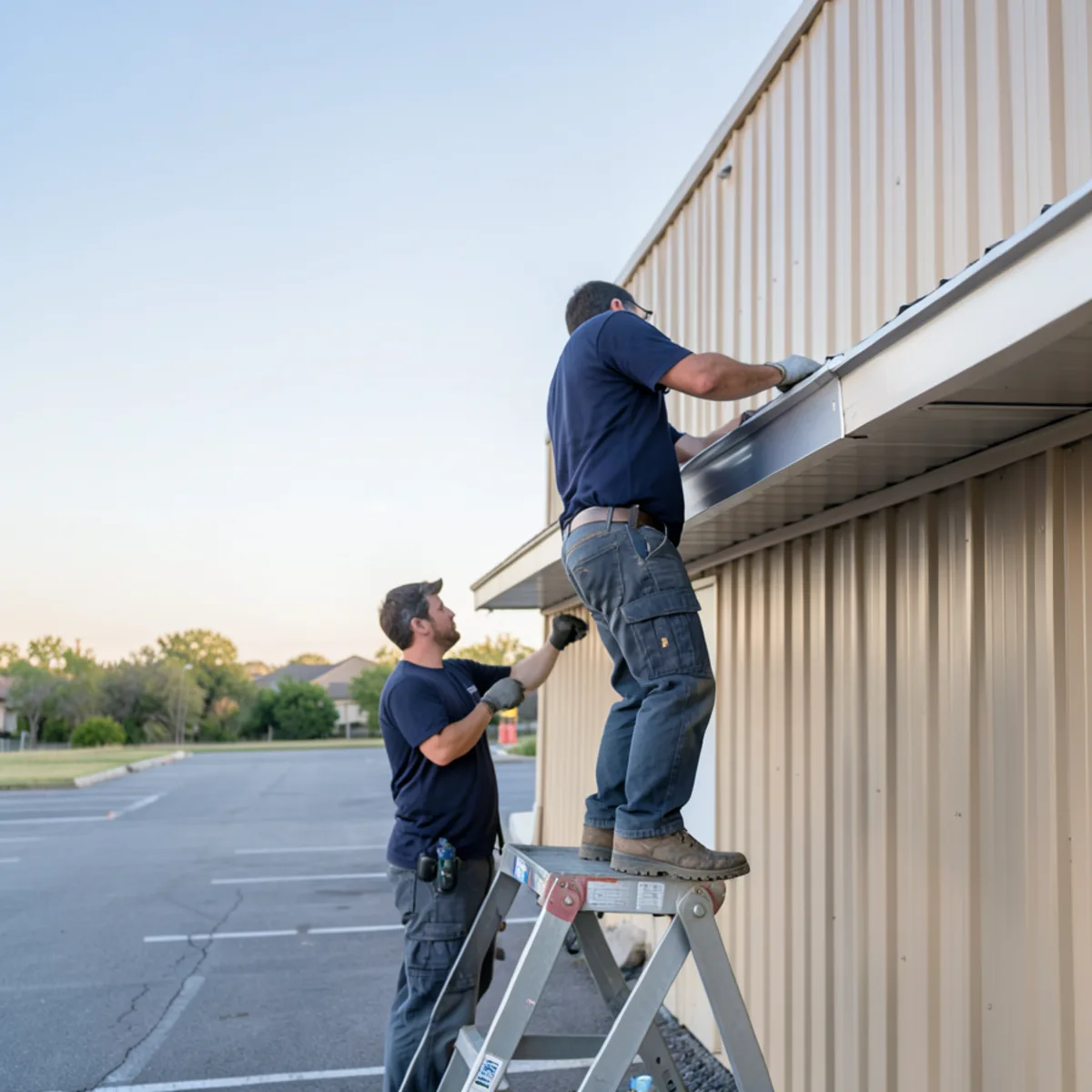
For most low-rise commercial buildings with a sloped roof, K-style is the simpler and cheaper answer. Box gutters earn their place on large roof areas, low-slope roofs that dump water fast and buildings where the gutter sits into the architecture. The box gutters vs K style choice comes down to the water at the eave and how it gets maintained.
What is the difference between box and K-style gutters?
The name describes the shape. A K-style gutter has a flat back and bottom with a decorative front face that looks a bit like a letter K from the side. It is the common residential profile, usually in 5-inch or 6-inch sizes, and it is roll-formed on site from aluminum coil. A box gutter is a square or rectangular channel. It holds more water for its width, and it is often fabricated from sheet metal to fit the building.
Box gutters come in two forms, and the difference matters. A hung box gutter fastens to the outside of the eave, like a large K-style. A built-in box gutter sits inside the cornice or roof structure, so a leak can run into the building instead of onto the sidewalk.
| Factor | K-style | Box |
|---|---|---|
| Shape | Flat back, shaped front | Square or rectangular |
| Typical sizes | 5-inch and 6-inch | Fabricated to suit the roof |
| Capacity | Fine for moderate roof areas | Higher for its width |
| Forming | Roll-formed on site in long runs | Often shop-fabricated sections |
| Joints | Corners and end caps only | Depends on section lengths and expansion joints |
| Failure risk | Overflow lands outside | A built-in leak can land inside |
| Best fit | Retail, office and small sloped roofs | Large or low-slope roofs, architectural eaves |
Have a commercial roofline in mind? Call (208) 464-4195 and we will confirm scope on the estimate.
- 4.5★ from 36 Google reviews
- Free estimates
- Run by owner Victor and his son Omar
When does a box gutter make sense on a commercial building?
Look at the roof first. A long, low-slope metal roof can send a lot of water to a single eave in minutes, and a 6-inch K-style may not keep up even with more downspouts. A box gutter fits these cases:
- A large drainage area feeding one eave.
- Metal roofs where water moves quickly and needs a wide target.
- Architecture that calls for a clean square line or a concealed gutter.
- Existing built-in gutters that have to be relined rather than removed.
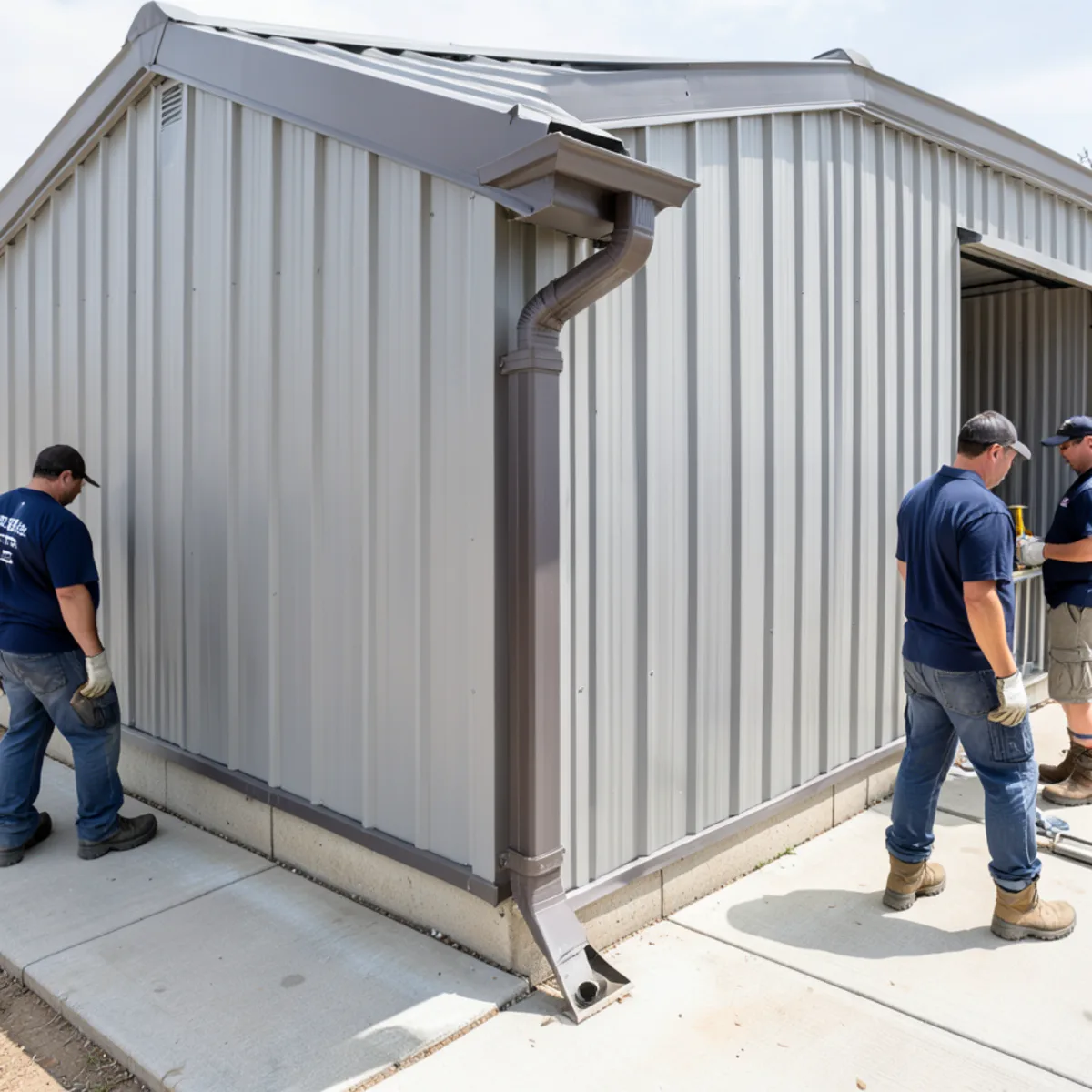
K-style stays the better choice for many retail strips, small offices and sloped roofs. It costs less, goes up fast and is simple to clean and repair. Before upsizing, add downspouts. The same rule that works on a house works here: more outlets often solve what looks like a capacity problem.
Box gutters vs K style: how do you size them?
Size by the rain, the roof and the outlets, in that order. On a house, a baseline of 1 square inch of downspout per 100 square feet of roof gets you close, so a 2x3 downspout drains about 600 square feet and a 3x4 about 1,200. That rule of thumb is a house rule. Do not stretch it across a commercial roof.
Commercial work belongs to a design calculation. According to Professional Roofing's 2026 article on roof drains, the 2024 International Plumbing Code uses the 100-year hourly rainfall rate for the building's location, and secondary drainage is worked out in a similar way but assumes the primary drains are blocked. On a larger building, get your architect, engineer or roofing consultant to set the design rate, and confirm which code edition your city has adopted. Round Rock, Austin and other cities each run their own permit offices, so check locally rather than assuming one rule.
Local rain makes this more than paperwork. Austin's average is 36.3 inches a year on the NOAA normals, but the City of Austin notes bursts of more than 5 inches in several hours. That is what a commercial gutter has to survive.
Ask where the water goes when an outlet clogs
Secondary drainage assumes the primary drains are blocked, and that question is worth asking of any gutter. A K-style or hung box gutter that clogs spills outward, over the front lip and onto the walk. A built-in gutter has no outward path unless someone designed one, so water can back up into the wall or soffit. Ask to see the overflow path on the drawings.
What does each profile cost to own?
The install price is only the first line. These are the items that move the cost over the years, so have them answered on a written quote.
| Item | K-style | Box |
|---|---|---|
| Access | Ladder or lift, set by eave height | The same, plus roof access for built-in runs |
| Inspection | Mostly visible from the ground | Built-in linings need a scheduled close look |
| Cleaning | Scoop and flush | Hung runs are similar; built-in runs need care around the lining |
| Repair | Reseal a corner or swap a section | Often a fabricated part or lining repair |
| Failure cost | Water on the walk | A built-in leak can reach soffits and finishes |
| Replacement | Take down and form a new run | Built-in work can reach the roof edge and cornice |
Why do built-in box gutters fail?
Mostly because nobody sees them. A trade article in Roofing magazine on built-in gutters lists the usual causes: cracked joints from expansion and contraction, corrosion pinholes in the lining and localized damage from limbs and debris. Warning signs show up below, as peeling paint and decay in the soffit, dark stains and mildew. The same article warns against patching a lining with roofing tar, since it hides the real condition and can corrode the metal.
Three habits keep a built-in system alive:
- Inspect it on a schedule, and clear leaves and debris as often as the site needs.
- Fix small leaks early, because the repair stays smaller and cheaper.
- Use compatible materials on the lining, and keep tar and bitumen off it.
What commercial roofs do to gutters
Commercial runs fail for different reasons than house gutters, mostly because more people walk the roof and fewer people look in the gutter.
- Roof traffic and HVAC work leave screws and offcuts in gutters, which can puncture linings or clog outlets.
- Long metal runs grow and shrink with heat. Runs without room to move tend to split at the joints.
- An undersized outlet defeats a large gutter. The gutter is only as good as its downspouts.
- Parking lots and sidewalks change the stakes. Overflow onto a walkway is a slip problem as well as a maintenance one.
The real trade-off is where you want a failure to land. A hung gutter, box or K-style, fails in plain view: ugly overflow, a wet walk, a simple fix. A built-in gutter gives the building its cleanest line and fails out of sight. If you own a concealed gutter, treat it as part of the roof and budget for inspections. If you are building new, choose concealed only when the architecture needs it, and put the overflow path and inspection access in the design.

What about older commercial buildings in Round Rock?
Established areas around Round Rock carry plenty of aging builder gutters, and the same holds for older commercial strips. If the K-style is thin, undersized or leaking at the joints, look at replacing it in heavier stock such as .032 aluminum, in a larger size with seamless gutters roll-formed on site. If the building has a concealed gutter, have the lining inspected before you price anything else, because the condition of that lining decides the scope.
Which one should you choose?
Pick K-style for a sloped roof with moderate drainage area and easy access. Pick a box gutter when the roof area, the slope or the architecture rules K-style out. Keep any built-in gutter on a set inspection schedule. Box gutter fabrication and relining vary by building, so ask us when you call, and we will confirm scope on the estimate. Ask about commercial gutters and commercial gutter cleaning at the same time, since cleaning access usually shapes the design. Call with the roof size and what overflows today, and we will tell you what we can take on.
Sources
Common questions
Are box gutters always bigger than K-style?
Not always in nominal size, but a box profile usually holds more water at the same width because its walls run straight up. Actual capacity also depends on depth, slope and outlets. A narrow outlet on a deep box gutter still backs up, so compare outlet size and downspout count along with the gutter dimensions.
Can a built-in box gutter be replaced with K-style?
Sometimes, but it changes the look and the eave detail. Removing a built-in gutter means reworking the roof edge and cornice, and on a designated historic building that change may need approval. Relining is often the simpler path. Have the gutter inspected, and ask your roofer or consultant to price both options in writing.
Are box gutters harder to clean than K-style?
Not usually. A hung box gutter is open and wide, so it scoops and flushes much like K-style, and eave height sets the access cost. Built-in runs take more care. Someone has to work along the roof edge, and metal tools can scratch the lining, so ask for plastic scoops and a written note of what they find.
Do Round Rock commercial sites need longer downspout runs?
Often, on the east side. Round Rock straddles the Balcones Escarpment, and east of I-35 the ground turns to Blackland clay, so carry discharge 6 to 10 feet from the foundation or into a drain the site already has. West of I-35, stony ground sheds water fast, so check where it goes next.
About the author
Written by the crew at V&V Seamless Gutters, the Austin gutter company run by owner Victor and his son Omar. Read more about us or see what customers say.
Related service: box gutters in Austin. We also work in Round Rock.
Have a gutter question this article did not answer?
- 4.5★ from 36 Google reviews
- Free estimates
- Run by owner Victor and his son Omar