
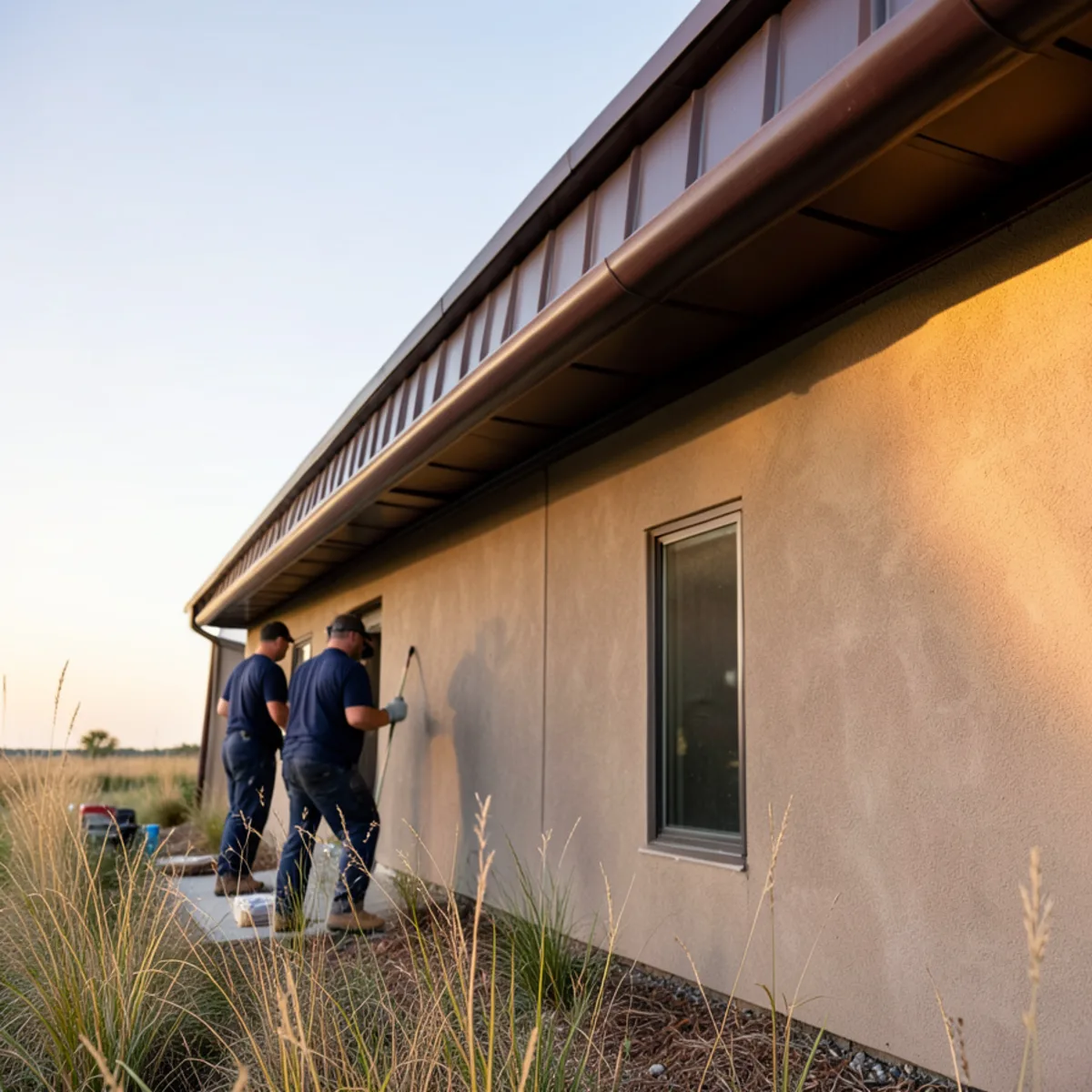
Decide this first: does the gutter hang on the outside of the building, or is it part of the building? A hung box gutter comes off like any other gutter. A built-in one sits inside the cornice or behind the roof edge, so a leak there can go straight into the structure. New Zealand's building research group BRANZ makes that point directly: if an internal gutter overflows, water can enter the building.
What is a box gutter, and which kind do you have?
| Type | Where it sits | Where it fails | What the job looks like |
|---|---|---|---|
| Hung box gutter | Outside the eave, on hangers or brackets | Corners, outlets, loose brackets | A gutter install, sized for the roof |
| Built-in box gutter | Inside the cornice or roof edge, with a lining | Lining, laps, outlets, the structure under it | Lining and carpentry, often with a roofer |
| K-style | Outside the eave, on the fascia | Corners and end caps | The usual gutter install |
| Half-round | Outside the eave, on brackets | Bracket spacing, undersized for the roof | Older-home look, more care with sizing |
Not sure which you have? Stand under the eave. If you can see a separate metal trough with brackets, it is hung. If the roof edge simply ends and the gutter is hidden from below, it is likely built-in. Send a photo and we can talk it through before anyone climbs a ladder.
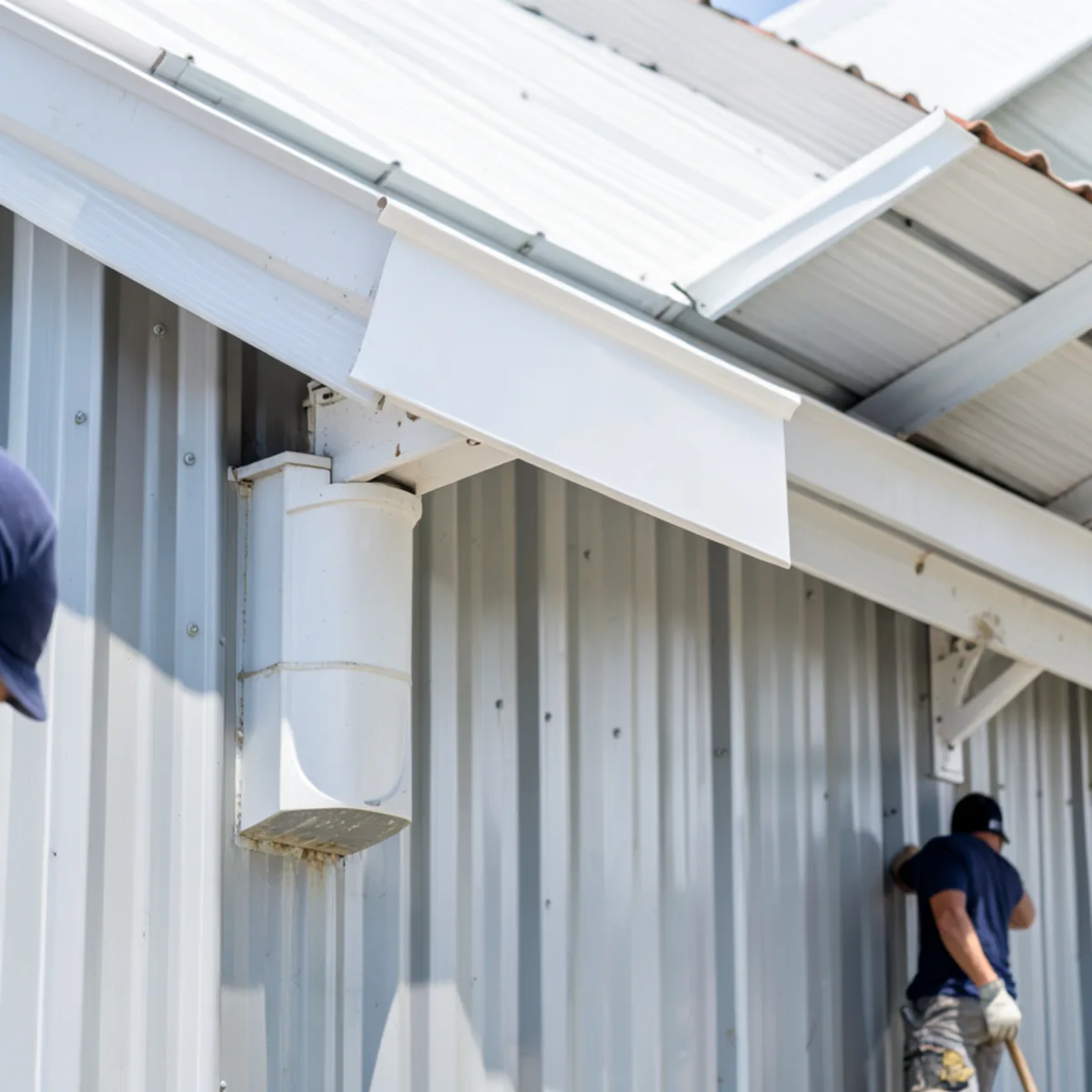
What a box gutter job includes
On a hung box gutter, the job is close to any gutter install, with more planning at the outlets. We identify the system, measure each run and work out how much roof feeds it. Confirm profile, metal and forming method on the call or quote. On built-in work, the quote separates gutter work from roofer or carpenter work.
- Identification. Hung or built-in, and what is failing.
- Measurement. Linear feet, the roof draining to each run, and outlet locations.
- Removal. Old run hauled off, fascia and brackets checked.
- New run. Profile, metal and slope stated on the written quote.
- Outlets. Downspout count, size and discharge at each one.
When does a custom box gutter make sense?
Add downspouts before assuming the gutter is too small. That rule saves more money than any upgrade. A box profile earns its place in a few specific cases:
- Long eaves on metal buildings, where one wall collects a large roof and needs a deep, wide trough.
- Square-edged architecture, where the owner wants a flat face instead of the K-style curve.
- A building that already has box gutters, where matching the look matters to the owner or a review board.
- A valley that dumps a heavy stream onto one short section of gutter.
On most Austin houses, a 6-inch K-style with 3x4 downspouts answers the capacity question at less trouble. Some owners want box anyway for the look, which is a fair reason. It just should not be sold as the only fix for overflow.
Signs a built-in or box gutter is failing
Built-in gutters hide their trouble. Roofing magazine lists the warnings: peeling paint or decayed wood in the soffit, dark stains on the wall, and water stains in the attic. Inspectors also look for cracks at joints and pinhole corrosion in the lining. On a hung box gutter, look for pulled brackets and drips at corners. Do not patch a lining with roofing tar, which the magazine warns hides and corrodes the metal.
Care is simple but matters more here. A box gutter's flat bottom holds debris and a clogged outlet backs up fast, and on a built-in gutter that backup sits against the building. West Virginia University Extension advises cleaning at least twice a year and after major storms. Micro-mesh gutter guards cut that cleaning, but they do not end it.
Send a photo of the eave and we will tell you which type you have and what a site visit should cover.
- 4.5★ from 36 Google reviews
- Free estimates
- Run by owner Victor and his son Omar
Request a free quote
Calling is fastest: (208) 464-4195. Prefer to write? Use the form and we will get back to you.
Commercial box gutter sizing: rain rate, roof area, outlets
A box gutter is sized from three numbers. Get any one wrong and the extra depth does nothing.
- Rain rate. NOAA Atlas 14 puts a 100-year storm at downtown Austin at 4.79 inches per hour across a full hour, but 15.4 inches per hour across five minutes. Gutters get tested in those five minutes.
- Roof area. Count the roof that actually drains to that gutter, including any upper roof that dumps onto it.
- Outlets. The trough can hold water only as fast as the outlets release it. Our baseline is 1 square inch of downspout per 100 square feet of roof, so 3x4 handles about 1,200 square feet and 2x3 about 600.
For anything past an ordinary eave, SMACNA, the sheet metal industry's trade association, publishes a free downspout and gutter sizing calculator that accepts a local rain rate. Built-in gutters and scupper systems should get a designer's or roofer's review. Long metal runs also grow and shrink with temperature, and BRANZ guidance calls for an expansion joint at the stop end of an internal gutter, so ask how a long run will handle movement.

Steel box gutter or aluminum?
Material follows the roof and the job. For aluminum, .027 is the minimum we hang and .032 is the heavier option. Roll-forming shapes flat coil at the house, so seams sit only at corners and end caps.
Steel and other stock are a different question. Availability changes by job, so ask us when you call. The same goes for profile: not every box shape can be roll-formed in one length. Where sections must join, the laps get sealed and the quote should say so. Customers have picked from many colors, so ask to see what suits the trim.
Is half-round worth asking about?
Yes, if the building is older or the look matters. Half-round is a half-circle trough on brackets, usually paired with round downspouts, and it suits houses that predate K-style. We have offered half-round as well as box, so ask when you call. We confirm what we can do on the estimate.
Know the trade-off first. A 5-inch half-round has about 9.8 square inches of cross-section, against about 14.1 for a 5-inch K-style by The Roofing Brief's published estimates. A 6-inch half-round gets back to about 14.1. So on a good-sized roof, plan on going up one size or adding downspouts.
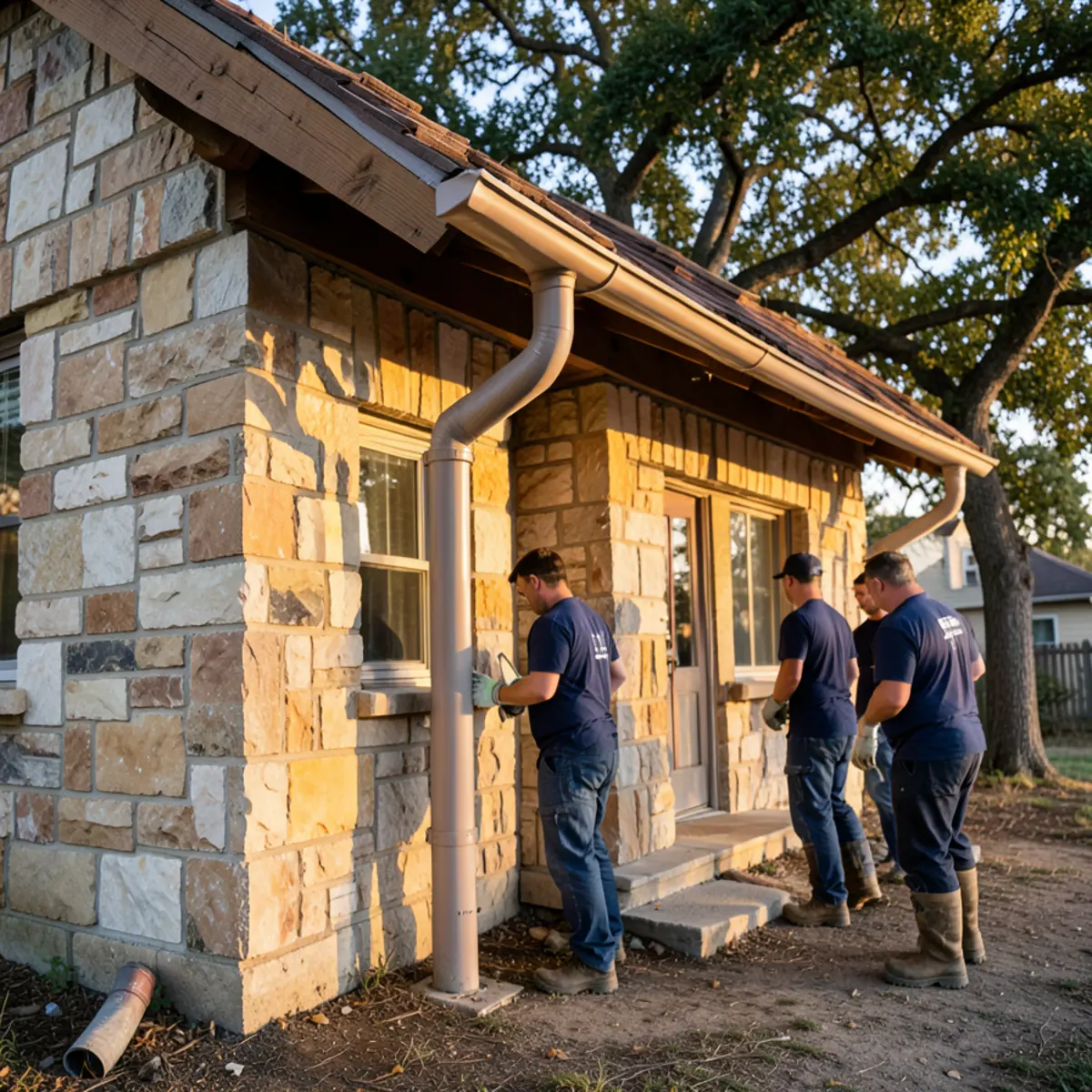
How a box gutter job runs, and what it costs
- Free estimate. We identify the gutter type, measure linear feet, check the fascia and mark downspout locations.
- Scope call. For built-in gutters, we say what is gutter work and what belongs to a roofer or carpenter.
- Written line-item quote covering gauge, size, color, downspout count and guards.
- Install. Old gutters come off and the new run goes up at a slope of about 1/4 to 1/2 inch per 10 feet.
- Walkthrough after cleanup, with each outlet's discharge checked.
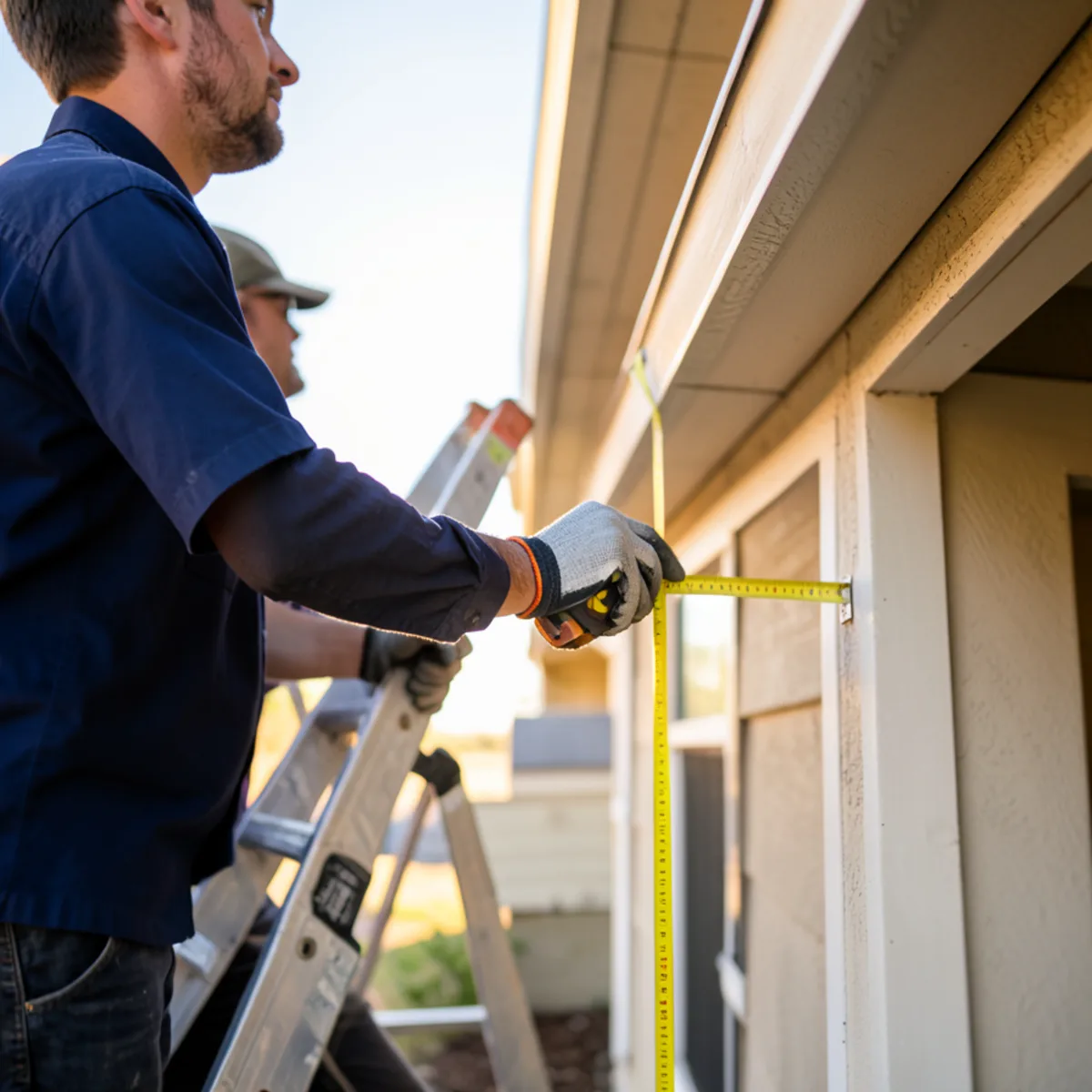
Box gutters are priced from the drawing or the measured job. Angi's 2026 Austin guide lists $4 to $10 per linear foot for local seamless installers, and those are house figures for standard gutters. Expect profile, height, access, outlet count and any lining or carpentry to drive the number. The estimate is free and the quote is written.
What moves a box gutter price
A profile formed in one length usually takes less labor than one built from sealed sections. Height matters, since a wall too tall for a ladder changes the plan. Long walls need more outlets, and each outlet adds material and labor. Metal choice, removal and any fascia repair each get a line. Built-in jobs add lining, carpentry and often a roofer's price.
Permits, codes and historic review for box gutter work
Austin's contractor registration applies to work under a building or trade permit, and the City's permit-exempt list does not name gutters, so ask Development Services. Texas has no statewide roofing contractor license, and no state gutter license was found, so verify insurance and references.
Historic buildings carry one more check. Before swapping a built-in gutter for a hung one, ask your local preservation office. Richmond, Virginia is one example: its review guidelines encourage repairing box and built-in gutters and will not approve suspended gutters where one is present. Austin and other Texas cities have their own rules, so check locally. In Austin, the Historic Landmark Commission reviews exterior changes to landmarks and local historic districts.
Why V&V for a box gutter estimate
None of the reviews below names a box gutter, so read them as proof of how the crew works, not of this profile. Daniel S. reports many jobs for his roofing company, and Sarmad B. had a new modern home fitted.
- We will tell you which type you have, including when the right call is a roofer.
- Trade references: a roofing company and a home builder have both used V&V, and one homeowner praised the range of gutter styles.
- Owner-run. Victor quotes the work and his son Omar leads installs.
- Written scope, so box work, carpentry and exclusions are spelled out before you approve.
“Victor and his crew have done many gutter jobs for my roofing company Accent Roofing and Remodeling and for my roofing customers. All custmers fompletely satisfied. Excellent quality and pricing..strongly recommend his sevice.”
“As a home builder, I had V&V install full gutters on a new modern home. Victor the owner was responsive, easy to work with and gave me a fair price. Victor’s son Omar and another young man did the actual installation. I was impressed with Omar. He is a sharp, meticulous, polite young man and easy to work with.”
“Great experience! They had so many different color options and gutter styles to choose from. You can't even tell our home has gutters unless you look closely. That's how well it matches to our house!”
From South Austin we reach buildings across the metro, including Round Rock, Georgetown and Buda. See the main commercial gutters page for how we scope larger buildings.
Sources
- NOAA Atlas 14, Precipitation Frequency Data Server (Texas, downtown Austin point)
- BRANZ: Designing gutters to cope with high rainfall
- SMACNA Downspout and Gutter Sizing Calculator
- The Roofing Brief: gutter dimensions
- City of Richmond Commission of Architectural Review: gutter and downspout guidelines
- Roofing: built-in gutters should be carefully inspected, restored and maintained
- City of Austin contractor registration
- City of Austin: Work Exempt from Building Permits
- City of Austin Historic Landmarks, Historic Preservation Office
Common questions
Are box gutters better than K-style on a metal building?
Not automatically. A box profile can carry more on a long eave, but the outlets decide how fast water leaves. A 6-inch K-style with extra 3x4 downspouts is often enough. Box makes more sense on very long walls or where the owner wants a flat face. We compare both on the estimate.
Can you repair a built-in box gutter?
Sometimes, and we confirm that on the estimate after seeing it. A small outlet or lap problem may be simple. A failed lining or rotted wood underneath is roofing and carpentry work, and it may need a roofer alongside us. We will say which part is ours, and put anything we cannot take on in the scope notes.
Can a built-in gutter be replaced with a hung gutter?
Often, on an ordinary building, once the old gutter is closed off and the roof edge is rebuilt so water reaches the new gutter. That roof-edge work goes beyond gutter hanging, so plan on a roofer. On a historic property, check with the local preservation office first, since some review boards will not approve the swap.
How deep should a box gutter be?
There is no single depth. It follows the roof area draining to it, the local rain rate and the outlets. Austin's short bursts run far above the hourly average, and a deep trough with too few outlets still overflows. For a standard eave, we size it from our downspout baseline. For built-in systems, ask for a designer's review.
Do you make box gutters on site?
Standard K-style is roll-formed on site from flat coil. Box profiles depend on the shape and the size, so we confirm how yours would be made on the estimate. If a run has to be built from joined sections, the quote should say so, because each lap is another joint to seal and to keep an eye on.
Will half-round gutters handle Austin rain?
Yes, if they are sized honestly. A half-round holds less than a K-style of the same width, so a heavy Austin burst can overrun a 5-inch half-round on a big roof. Going to 6-inch, adding downspouts, or both usually fixes that. Mention half-round when you call, and we will confirm what is possible on your house.
Related services
From the blog
Where we do this work
Austin and these nearby areas, among others on our service areas page:
- Gutter service in Round Rock: Established neighborhoods with aging builder gutters.
- Gutter service in Georgetown: Retirees seeking low-maintenance guards.
- Gutter service in Buda: Growing neighborhoods near Onion Creek.
- Gutter service in Pflugerville: Subdivisions with slab foundations on expansive clay.
- Gutter service in Taylor: Older homes near major new industry.
- Gutter service in Lockhart: Historic homes around the courthouse square.
- Gutter service in Elgin: Historic downtown and new homes on clay soil.
- Gutter service in San Marcos: College town with heavy rental stock.